Showing posts with label Communication. Show all posts

Thursday, February 18, 2021

MA(JMC) FIRST PAPER (Basic Principles of Communication & Mass-Communication)

MAJMC – I Semester                              Course Code: MAJMC 01

Credits Equivalent: 4 Credits (One credit is equivalent to 10 hours of lectures / organized classroom activity / contact hours; 5 hours of writing work / practical / field work / tutorial / teacher-led activities and 15 hours of other workload such as independent / group work / house journals; obligatory / optional work placement; literature survey / library work; writing of papers / presentations / seminars, etc.)

Course Objectives: The Course is designed to:

• Introduce the students to the field of communication.

• Apprise the students of fundamentals of Mass Communication.

• Assist the students in developing theoretical and conceptual understanding of the field.

• Demonstrate skill and knowledge as producers of media.

Learning Outcomes:

After completion of the course the learners will be able:

• To enhance the knowledge of students with regard to the fundamentals of communication and its different forms.

• To know the elements of effective communication and barriers of communication.

• To illustrate the fundamentals of Mass Communication and its various forms.

• To describe the theories of communication that make the students understand about the role of communication in society and media.

• To understand various Communication Models and significance of Models in understanding communication process.

• To identify the target audience and segmentation of audience for the purpose of understanding communication process.

Evaluation Criteria:

1. Continuous Internal Assessment: 30%

2. End Term Examination: 70%

Course Contents

UNIT I

• Defining communication : Elements and process

• Types of communication.

• Need, functions and significance of communication.

• Concept of Mass.

• Defining Mass Communication.

• Marshall McLuhan: Global Village

UNIT II

• Aristotle’s Model of Communication

• David K. Berlo’s SMCR Model

• Harold D. Lasswell’s Model

• Shannon and Weaver’s Model

• Charles E. Osgood’s Model

• George Gerbner’s Model

• Theodore M. Newcomb’s Model

• Westley & McLean’s Model

• Frank Dance’s model

• Wilbur Schramm’s Model

UNIT III

• Bullet theory.

• Individual Difference theory.

• Personal Influence theory.

• Cognitive Dissonance Theory

• Sociological Theories: Cultivation Theory, Agenda Setting Theory, The Uses and Gratification Theory, Dependency Theory

UNIT IV

• Normative Theories: Authoritarian Theory, Free Press Theory, Social Responsibility Theory, Communist Media Theory, Development Communication Theory, Democratic-Participant Media Theory

• Hegemony Theory

UNIT V

• Mass communication as an agent of Social change

• Demassification, Demystification, Decentralization and convergence

• Characteristics of Audiences, audience fragmentation,

• Type of audiences: Elite audience, General audience, specialized audience, target audience

• Limitations of Mass Communication

Suggested Readings :-

1. Mass-Communication in India: Kevel J. Kumar: Jaico Mumbai

2. Mass-Communication theory-An Introduction:Denis McQuail:Sage Delhi

3. Bharat Men Sanchar aur Jansanchar:J.V.Vilanilam:M.P. Hindi Granth Academy Bhopal

4. Mass-Communication: Concepts and issues: D.V.R Murthy:Olive green:Kochi

5. Mass, Culture, Language and arts in India: Mahadev L.Apte: Popular Prakashan, Mumbai

6. Towards sociology of Mass-Communication: Denis McQuail:Collier –Macmillan

7. News,Information & Communication: Dr. Mukul Srivastava, New Royal Book Company Lucknow.

8. The process and Effects of Mass-Communication: Wilbur Schramm and Donald F. Roberts: University of Illinois press.

9. Introduction to Communication Studies: John Fiske: Methuen London

10. Soochna Sanchar aur Samachar, Dr. Mukul Srivastava, New Royal Book Company, Lucknow.

Normative Theory – Four Theories of the Press

Introduction:

Normative theories were first proposed by Fred Siebert, Theodore Peterson and Wilbur Schramm in their book called “Four Theories of the Press”. At first the word “Normative Theory” was pronounced in USA during the height of ‘cold war’ with communism and soviet. Often it called as western theories of mass media.
A Normative theory describes an ideal way for a media system to be controlled and operated by the government, authority, leader and public. These theories are basically different from other communication theories because normative theories of press are not providing any scientific explanations or prediction. At the same these “four theories of the press” were came from many sources rather than a single source. Sometimes media practitioners, social critics and academics also involved to develop these normative theories.
Normative theories are more focused in the relationship between Press and the Government than press and the audience. These theories are more concern about the ownership of the media and who controls the press or media in the country.

The four theories of the Press/Media
Authoritarian theory
Libertarian theory
Social responsibility theory
Soviet media theory

Few questions will helps to understand the needs of the normative theories
Is media can published or broadcast any type’s of content will earn more profits in a shortest time? (think about Yellow journalism / Talbots )
Is media can provide any public service even if no immediate profits can be earned?
Is media can participate in any issues and solving the social problems?
Is it essential for media to protect the consumers from the culprits, business frauds and corrupt bureaucrats by serving as a watch dog?
What people expect from media during the time of crisis?
Is media should broadcast the highly rated content even if it has high level of violence?
Is a news paper publishing the unethical business content to encourage the company for its higher advertisements pay?

These questions are linked and concerned about the media day-to-day activities.

Examples:
In 1996, NBC news department accused an innocent man in Atlantic Olympic bombing.
In 1998, ABC radio falsely announced the death of the great comedian “Bob Hope” after receiving the error message from associated press.
Past few years how wiki leaks releasing the classified documents in online media and its effect.

Concepts in Normative Theories of the Press

Media became competitive and yellow journalism developed in the nineteenth century. Media used sensationalism to attract people to use media like newspapers more. So, normative theories of press were developed to understand the use and responsibilities of media for general public through the relationship of media and governments.
These theories were made to clean media practices and guide the press. Accuracy and objectivity was taken to be the major improvement factors. These theories tell media how they should behave even though their philosophies are different.
Normative theory of press describes what role media takes in which kinds of government. It shows the ideal path to be taken by media, structures that media can adopt and operation of media.
Media must be clean and yellow journalism should be avoided in all the press theories in practice. Media must always be credible, truthful and reliable. Although very few countries have a media that falls under a clear category and there is often a mixture of two or more theories, understanding these theories can help us get the bigger picture of the effect of the environment in which media operates on it.

Types and Examples of Normative Theories of the Press
Authoritarian Theory

Authoritarian theory of press is the control of media with government, elites or authorities. Media is not allowed to criticize the powerful people or the government. There is censorship by government on criticisms and other things negatively portrayed about them.
Similarly, licensing of media, punishments and content approval are other means used to curb full freedom of press. Media is taken as a means to serve the interest of authorities and state. The reason given as to why it is done is “to achieve social order”.
The theory ignores needs of people and only establishes agendas and propaganda. There is limited freedom. The press in Bhutan can be taken as an example of authoritarian theory in practice.

Libertarian or Free Press Theory

Libertarian theory came in opposition to authoritarian theory. Press was given more freedom and people involved were taken to be conscience and intellectual. They were believed to possess the capability to find out truth from false. Public engagement was also started. People were given a lot of press freedom and there was little to no government control over press. “Laissez-faire” approach was used.
There were some restrictions in place for libel, false advertising and false news, but for the most part, media was different body rather than a part of the government. Media could criticize government and serve as gatekeepers or watchdogs for the society. It ignored privacy and worked for capitalism. An example of it was U.S. adopting it after the declaration of independence.

Social Responsibility Theory

In social responsibility theory, press is given freedom to publish anything but has to be responsible in its actions. The main role of press is to help preserve and growth of democracy. Guidelines and regulations make the press behave in a responsible manner. Government can censor if it deems some information to be inappropriate for democracy and social order.
Audience is also taken to be responsible in their understanding of things shown in media. Government can not intrude media as per its will. Media is taken to be a spokesperson of the poor and marginalized as well as provides diverse views/perspectives
It ignores corporations using press for commercialization and profit. It is found in most European countries and other countries under European influence around the world nowadays.

Communist Theory

Communist theory is also known as the Soviet Theory as it came from the then Soviet Union after Russian Revolution of 1917. The main role of media in communist theory is to promote communism and achieve communist goals. The main representatives of communist power control the media. Information is controlled and is used to develop people’s skills and fulfill their basic needs.
The target population is the working class people. It is more liberal than authoritarian theory on information content in press. Media is self regulatory and there is no censorship. An example of this theory is how press functions in China.

Additions to Normative Theories of the Press

McQuail is another theorist who added two more theories to the four normative theories. One is Democratic-Participant Media Theory and the other is developmental media (development communication) theory. The first one talks about participation of audience in media. The second talks about media as a tool for development in local level.
Normative theories are based on different types of government systems. So, which one is good can not be measured by it. Media is important for states to survive and can be used in any way the government wants it to.
There are other theories that have emerged after the normative theories to better their aspects. Some of them are: Western concept (including both Libertarianism and Social Responsibility), Development Concept Theory, Revolutionary Concept Theory, Transitional Media Approach, etc.


नियामक सिद्धांत (Normative Theories) प्रेस के चार सिद्धांत (फोर थ्योरी ऑफ़ प्रेस)

समाज की अपनी सामाजिक व राजनैतिक व्यवस्था होती है। कुछ नियम व आदर्श होते हैं। इसी व्यवस्था के तहत नियम व आदर्श को ध्यान में रखकर संचार माध्यमों को अपना कार्य करना पड़ता है। संचार माध्यमों के प्रभाव से सामाजिक व राजनैतिक व्यवस्था न केवल प्रभावित, बल्कि परिवर्तित भी होती है। यहीं कारण है कि संचार विशेषज्ञ सदैव यह जानने के लिए प्रयासरत रहते है कि समाज का सामाजिक व राजनैतिक परिवरेश कैसा है? किसी देश व समाज के संचार माध्यमों को समझने के लिए उस देश व समाज की आर्थिक व राजनैतिक व्यवस्था, भौगोलिक परिस्थिति तथा जनसंख्या को जानना महत्वपूर्ण है, क्योंकि इसके अभाव में संचार माध्यमों का विकास व विस्तार असंभव है। इस सम्बन्ध में संचार विशेषज्ञ फ्रेडरिक सिबर्ट, थियोडोर पीटरसन तथा विलबर श्राम ने 1956 में प्रकाशित अपनी चर्चित पुस्तक Four Theories of the Press के अंतर्गत प्रेस के चार प्रमुख सिद्धांतों की विस्तृत व्याख्या की है, जिसे नियामक सिद्धांत कहा जाता है। जो निम्नलिखित हैं :-
प्रभुत्ववादी सिद्धांत ((Authoritarian Theories)
उदारवादी सिद्धांत (Libertarian Theories)
सामाजिक उत्तरदायित्व का सिद्धांत (Social Responsibility Theories)
साम्यवादी मीडिया सिद्धांत ( ( Communist Media Theories)
 
इन चारों सिद्धांतों का प्रतिपादन प्रेस के संदर्भ में किया गया है। बाद में संचार विशेषज्ञों ने इसे मास मीडिया के संदर्भ में देखते हुए दो अन्य सिद्धांतों को प्रतिपादित करके जोड़ा है।
लोकतांत्रिक भागीदारी का सिद्धांत (Democratic Participant Theories)
विकास माध्यम सिद्धांत (Development Media Theories)

प्रभुत्ववादी सिद्धांत
(Authoritarian Theories)

प्राचीन काल के शासकों का अपने साम्राज्य पर पूर्ण नियंत्रण होता था। उसे सर्वशक्तिमान तथा ईश्वर का दूत माना जाता था। ग्रीक दार्शनिक प्लेटो ने अपने दार्शनिक राजा के सिद्धांत में शक्तिशाली राजा का उल्लेख किया है। प्रभुत्ववादी या निरंकुश शासन-व्यवस्था में व्यक्ति व समाज के पास कोई अधिकार नहीं होता है। उसके लिए शासक वर्ग की आज्ञा का पालन करना अनिवार्य होता है। ऐसी व्यवस्था में शासक को उसके कार्यों के लिए उत्तरदायी ठहराने के लिए विधि का अभाव होता है। मध्य युगीन इटली के दार्शनिक मेकियावली ने अपनी पुस्तक The Prince में शासक को सत्ता के लिए सभी विकल्पों का प्रयोग करने का उल्लेख किया है। इसका तात्पर्य यह है कि शासक के शक्ति-प्रयोग व दुरूपयोग पर किसी प्रकार का परम्परागत या वैधानिक प्रतिबंध नहीं होता है। तत्कालीक शासक वर्ग की प्रेस से अपेक्षा होती थी कि वह यह प्रचारित करें कि ...शासक वर्ग सर्वोपरि है। ...उसके जुबान से निकला हर वाक्य कानून है। ...शासक वर्ग पर कोई अंगुली नहीं उठा सकता है। ...शासक वर्ग का काम शासितों की भलाई करना है, जिसे वे बखूबी तरीके से कर रहे हैं ...इत्यादि।
1440 में हालैण्ड के जॉनगुटेन वर्ग ने टाइप का आविष्कार किया। इसके बाद प्रिंटिंग प्रेस अस्तित्व में आया। उस दौरान दुनिया के अधिकांश देशों (राज्यों) में प्रभुत्ववादी या निरंकुश शासन-व्यवस्था प्रभावी थी, जिसके शासक वर्ग को सर्वशक्तिमान तथा सर्वगुण सम्पन्न समझा जाता था। अपने अस्तित्व को बनाये व बचाये रखने के लिए शासक वर्ग प्रेस की आजादी के पक्षधर नहीं थे। अत: प्रेस पर अपना नियंत्रण रखने के लिए निम्नलिखित नियमों को बना दिया :-
लाइसेंस प्रणाली : प्राचीन काल में शासक वर्ग ने प्रेस पर प्रभावी तरीके से नियंत्रण रखने के लिए प्रिंटिंग प्रेस लगाने के लिए लाइसेंस अनिवार्य कर दिया। शासक वर्ग को नजर अंदाज करने पर लाइसेंस रद्द करने की व्यवस्था थी।
सेंसरशिप कानून : लाइसेंस लेने के बावजूद प्रेस को कुछ भी प्रकाशित करने का अधिकार नहीं था। सेंसरशिप कानून के अनुपालन तथा सत्ता विरोधी सामग्री के प्रकाशन पर प्रतियों का प्रसारण रोकने का अधिकार शासक वर्ग के पास था।
सजा : शासक वर्ग की नीतियों के विरूद्ध कार्य करने पर जुर्माना व कारावास के सजा की व्यवस्था थी। ब्रिटेन में प्रेस के लिए लाइसेंस लेने की व्यवस्था हेनरी अष्टम के कार्यकाल में प्रारंभ हुआ। धर्म प्रचार सामग्री प्रकाशित करने के लिए भी अनुबंध पत्र भरना तथा निर्धारित शुल्क भुगतान करना पड़ता था। 1663 में ब्रिटेन के एक मुद्रक जॉन ट्वीन ने एक पुस्तक प्रकाशित किया, जिसमें लिखा था कि- राजा को प्रजा के प्रति उत्तरदायी होना चाहिए। वर्तमान लोकतांत्रिक शासन-व्यवस्था में यह सामान्य बात है, लेकिन प्रभुत्ववादी या निरंकुश शासन-व्यवस्था में राजद्रोह के समान थी। लिहाजा, जॉन ट्वीन को फांसी की सजा दी गयी। जबकि उक्त पुस्तक को जॉन ट्वीन ने केवल प्रकाशित किया था, स्वयं लिखा नहीं था। राजद्रोह का नियम प्रेस को नियंत्रित करने का एक तरीका है। इसका सर्व प्रथम उपयोग 13वीं शताब्दी में शासक वर्ग के विरूद्ध समाज में अफवाह, षड्यंत्र तथा आलोचना रोकने के लिए किया गया।
1712 में ब्रिटिश संसद ने समाचार पत्रों पर अपना नियंत्रण व प्रभाव बढ़ाने के लिए स्टाम्प टैक्स लागू कर दिया, जिसमें सत्ता का विरोध करने वाले प्रेस के खिलाफ कठोर दण्डात्मक कार्रवाई करने का प्रावधान था। इसके अलावा समय-समय पर शासक वर्ग द्वारा कूूटनीतिक तरीके से भी प्रेस को अपने नियंत्रण में लेने का प्रयास किया जाता रहा है। जैसे- शासक वर्ग द्वारा अपना समाचार पत्र प्रकाशित करना, सत्ता पक्ष की चाटुकारिता करने वाले प्रेस को विशेष सुविधा देना इत्यादि। 20वीं सदी में हिटलर ने जर्मनी में निरंकुश सत्ता का बर्बरतम रूप प्रस्तुत करते हुए प्रेस पर कठोर प्रावधान लगाये। स्वाधीनता आंदोलन के दौरान भारत में प्रेस को अंग्रेजों के कठोर काले कानूनों का शिकार होना पड़ा।

उदारवादी सिद्धांत
(Libertarian Theories)

यह सिद्धांत प्रभुत्ववादी सिद्धांत के विपरीत हैं। उदारवादी सिद्धांत की अवधारणा का बीजारोपण १६वीं शताब्दी में औद्योगिक क्रांति के साथ हुआ, जो 17वीं शताब्दी में अंकुरित तथा 18वीं शताब्दी में विकास हुई। इस सिद्धांत व विचारधारा को लोगों ने 19वीं शताब्दी में फूलते-फलते हुए देखा गया। लोकतंत्र के अभ्युदय, अभिव्यक्ति की स्वतंत्रता, सेंसरशिप मुक्त की स्थापना तथा सूचनाओं की पारदर्शिता में उदारवादी सिद्धांत का विशेष योगदान है। इस सिद्धांत के अनुसार- अभिव्यक्ति की स्वतंत्रता मानव जीवन का आधार तथा प्रेस को अभिव्यक्ति की स्वतंत्रता का प्रमुख हथियार है। सामान्य शब्दों में, उदारवादी सिद्धांत के अनुसार मानव के मन में अपने विचारों को किसी भी रूप में प्रकट करने, संगठित करने तथा जिस तरह से चाहे वैसे अभिव्यक्त (छपवाने) करने की स्वतंत्रता महसूस होनी चाहिए।
फ्रांस की क्रांति तथा 19वीं सदी में विभिन्न नागरिक अधिकारों की अवधारणा से प्रेस की स्वतंत्रता की विचारधारा को मजबूती मिली। उदारवादी शासन व्यवस्था में नागरिकों को विभिन्न प्रकार की स्वतंत्रता प्रदान की गई थी। इसका सीधा प्रभाव प्रेस पर भी देखने को मिला। परिणामत: विभिन्न प्रकार के प्रतिबंधों व सेंसरशिपों से प्रेस को मुक्ति मिलने लगी। स्वतंत्र प्रेस की आवश्यकता के सम्बन्ध में प्रसिद्ध विचारक जॉन मिल्टन, थॉमस जेफरसेन, जॉन स्टुवर्ट मिल ने महत्वपूर्ण विचार व्यक्ति किये थे। इनके अनुसार लोकतंत्र के लिए उदारवादी सिद्धांत का होना अनिवार्य है। उदारवादी सिद्धांत के समर्थकों का मानना है कि मानव विवेकवान होता है। यदि सरकार प्रेस को स्वतंत्र छोड़ दे तो लोगों को विभिन्न तथ्यों की जानकारी उपलब्ध हो सकेगी। इस संदर्भ में जॉन मिल्टन ने 1644 में अपना विचार शासक वर्ग के समक्ष रखा तथा अभिव्यक्ति की स्वतंत्रता का समर्थन करते हुए बगैर लाईसेंस के प्रेस स्थापित करने की सुविधा प्रदान करने की मांग की। अपनी पुस्तक ट्टएरियो पैजिटिकाट्ट में मिल्टन ने लिखा है कि मानव अपने विवेक एवं तर्क से सही-गलत तथा सत्य-असत्य का निर्णय कर सकता है।
उदारवादी सिद्धांत के संदर्भ में थॉमस जेफरसन का विचार है कि प्रेस का प्रमुख कार्य जनता को सूचित कर जागरूक बनाना है। शासक अपने कार्यों से विचलित न हो, इसके लिए प्रेस को जागरूक रहना चाहिए। थॉमस ने 1787 में अपने एक मित्र को लिखा कि- समाचार पत्र लोगों के विषय में सूचना व जानकारी को प्रसारित करते हैं। इससे जनभावना का निर्माण होता है। समाचार पत्र लोगों पर भावनात्मक प्रभाव भी उत्पन्न करते है। साथ ही थॉमस ने जॉच-पड़ताल के नाम पर लोगों को डराने-धमकाने वालों पर प्रतिबंध लगाने की मांग भी की। इस संदर्भ में दार्शनिक जॉन स्टुअर्ट मिल का विचार भी काफी महत्वपूर्ण हैं। मिल का विचार है कि मानव की मूूल प्रवृत्ति सोचने व कार्य करने तथा मूल उद्देश्य अधिकतम व्यक्तियों को अधिकतम सुख पहुंचाने की होनी चाहिए। 1859 में ट्टस्वतंत्रताट्ट नामक अपने निबंध में जॉन स्टुअर्ट मिल ने लिखा है कि यदि हम किसी विचार पर शांत या मौन रखने को कहते हैं तो हम सत्य को शांत और मौन कर देते हैं। मिल के इस दर्शन का अमेरिकी जनता ने समर्थन किया।
इन विचारकों द्वारा प्रभुत्ववादी सिद्धांत पर सवाल उठाने पर सुधारवादियों ने कैथोलिक चर्च तथा राज्य सत्ता को चुनौती देना प्रारंभ कर दिया, जिसके चलते मानव के अधिकार व ज्ञान का विकास हुआ। इसका एक कारण यह भी है कि उदारवादी सिद्धांत के अंतर्गत मानव के विवेक एवं स्वतंत्रता को विशेष महत्व प्रदान किया गया है तथा मानव को अपने विचारों का मालिक बताया गया है। साथ ही उउसे अपने विचारों, भावनाओं, मूल्यों को अभिव्यक्ति करने की स्वतंत्रता प्रदान की गयी है। इसी सिद्धांत व विचारधारा के कारण १९वीं शताब्दी में अमेरिका में लोकतंत्र की स्थापना हुई, जिसके अंतर्गत जनता के द्वारा, जनता के लिए सरकर का गठन हुआ। अमेरिकी संविधान में प्रेस की स्वतंत्रता को सम्मलित किया गया है। इससे प्रेस को सेंसरशिप से मुक्ति मिली। वर्तमान में अमेरिका, न्यूजीलैण्ड, कनाडा, स्वीडन, ब्रिटेन, डेनमार्क समेत दुनिया के कई देशों में उदारवादी सिद्धांत और लोकतांत्रिक व्यवस्था को लेकर अध्ययन चल रहे हैं। पिटर्सन एवं श्राम का कथन है कि- जनमाध्यमों को लचीला होना चाहिए। जनमाध्यमों में समाज में होने वाले परिवर्तनों को ग्रहण करने की क्षमता होनी चाहिए। इसके अलावा जनमाध्यम को व्यक्तिगत विचारों तथा सत्य का उन्मुक्त वातावरण बनाते हुए मानव के हितों को आगे बढ़ाना चाहिए।
इस प्रकार, उदारवादी विचारधारा के प्रतिपादकों ने लोकतंत्र को सही सतरीके से चलाने के लिए लोगें को हर तरह की सूूचना में पारदर्शिता लाने तथा लोगों को उपलब्ध कराने पर जोर दिया है। यही कारण है कि 20वीं शताब्दी के अंतिम तथा 21वीं शताब्दी के पहले दशक में दुनिया के अनेक देशों में सूचना का अधिकार कानूनी को प्रभावी तरीके से लागू किया गया। भारतीय संसद ने सूचना का अधिकार अधिनियम-2005 को पारित कर लोकतांत्रिक व्यवस्था के तहत जनता के अधिकारों में बढ़ोत्तरी की। हालांकि सबसे पहले 1776 में स्वीडन ने सूचना के अधिकार को लागू किया।
आलोचना : उदारवादी सिद्धांत के जहां समर्थकों की संख्या जहां काफी अधिक हैं, वहीं आलोचकों की भी कमी नहीं है। आलोचकों का मानना है कि मौजूदा समय में उदारवादी सिद्धांत की मूल तथ्यों को भले ही वाह्य रूप में लागू किया गया है किन्तु अंतर्वस्तु में नहीं... क्योंकि जनमाध्यमों को प्रत्यक्ष या अप्रत्यक्ष नियंत्रित या प्रभावित करने वाले सरकारी व गैर सरकारी दबाव हित समूह मौजूद हैं। समाचार स्रोत अपने ढंग से भी ऐसा करते हैं। इस सिद्धांत के संदर्भ में कई बार ऐसे विचार प्रकट किये जा चुके हैं कि यदि कोई स्वतंत्रता का दुरूपयोग करें तो क्या किया जाए? दुरूपयोग को रोकने के लिए सरकार उपर्युक्त प्रतिबंध लगा सकती है, लेकिन विचार अभिव्यक्त या प्रसारित करने से पहले सेंसरशिप नहीं लगाया जा सकता है। हालांकि बाद में उसे उचित कारणों के आधार पर कानून के कटघरे में खड़ा करके उचित दण्ड दिया जा सकता है। इसका अर्थ विचारों का दमन नहीं हो सकता है।

सामाजिक उत्तरदायित्व सिद्धांत
(Social Responsibility Theories)

सामाजिक उत्तरदायित्व सिद्धांत का प्रतिपादन अमेरिका (1940) में स्वतंत्र एवं जिम्मेदार प्रेस के लिए गठित आयोग ने किया, जिसके अध्यक्ष कोलम्बिया विश्वविद्यालय के राबर्ट हटकिन्स थे। इस सिद्धांत को उदारवादी सिद्धांत की वैचारिक पृष्ठभूमि पर विकसित किया गया है। सामाजिक उत्तरदायित्व सिद्धांत के अनुसार- जनमाध्यम केवल समाज का दर्पण मात्र नहीं होता है, बल्कि इसके कुछ सामाजिक उत्तददायित्व भी होते हैं। इस संदर्भ में आर.डी. केस्मेयर ने आयोग के समक्ष कहा कि टेलीविजन न केवल समाज का, बल्कि जनता के संस्कारों एवं प्राथमिकताओं का भी दर्पण है। फ्रेंक स्टेन्फन का कथन है कि जन माध्यम समाज के दर्पण के रूप में कार्य करते हैं। किसी भी घटना को उसके वास्तविक रूप में प्रस्तुत करने का प्रयास करते हैं। साथ ही आर.डी. केस्मेयर व फे्रेंस स्टेन्फन समेत तमाम मीडिया कर्मियों का स्वीकार करना पड़ा कि जनमाध्यमों का कार्य समाज में घटी घटनाओं को पेश करना मात्र ही नहीं है, बल्कि इनके कुछ सामाजिक उत्तरदायित्व भी हैं। जनमाध्यमों का प्रमुख उत्तरदायित्व यह है कि वे अपने कार्यक्रमों के माध्यम से समाज में व्याप्त कुरीतियों को दूर करने, शिक्षा का प्रसार करने, साम्प्रदायिक सद्भावना व राष्ट्रीय एकता को बनाये रखने तथा देश हित की रक्षा में मदद करें। जनमाध्यमों को केवल समाज की इच्छा से नियंत्रित नहीं होना चाहिए, बल्कि एक अच्छे पथ प्रदर्शक की तरह समाज हित में उचित निर्णय भी लेना चाहिए।
अमेरिका में सामाजिक उत्तरदायित्व सिद्धांत का प्रतिपादन जनमाध्यम के विकास के बाद हुआ। 20वीं शताब्दी के चौथे दशक में अमेरिकी जनमाध्यमों में आपसी प्रतिस्पर्धा तथा व्यावसायिक हित के कारण समाचारों को सनसनीखेज तरीके से प्रस्तुत करने की होड़ लगी थी। इससे एक ओर जहां सामाजिक सरोकार प्रभावित हो रहे थे, वहीं उदारवादी सिद्धांत के आत्म नियंत्रण की अवधारणा समाप्त होने लगी थी। हटकिन्स आयोग ने जनमाध्यामें की इस प्रवृत्ति को लोकतांत्रिक व्यवस्था के लिए खतरनाक बताते हुए सामाजिक उत्तरदायित्व सिद्धांत का प्रतिपादन किया।
हटकिन्स आयोग का मानना है कि प्रेस की स्वतंत्रता सामाजिक उत्तरदायित्व में निहित है। यह सिद्धांत वास्तव में उदारवादी सिद्धांत पर आधारित है तथा उसी की वैचारिक पृष्ठभूमि पर विकसित हुआ है। यह सिद्धांत एक ओर जनमाध्यमों की स्वायत्ता को स्वीकार करता है तो दूसरी ओर उसके सामाजिक उत्तरदायित्व को भी याद दिलाता है। अत: जनमाध्यमों की सामग्री सनसनीखेज नहीं बल्कि सामाजिक उत्तरदायित्व पर केंद्रीत व सत्य परख होनी चाहिए। इसके लिए आयोग ने एक नियमावली व्यवस्था लागू करने का सुझाव भी दिया है, जिसे प्रेस के क्रिया-कलाप को ध्यान में रखकर तैयार किया गया है। हटकिन्स आयोग ने कुछ सरकारी कानूनों का सुझाव दिया, जिसमें प्रेस के मुनाफाखोर या गैर-जिम्मेदार होने की स्थिति में स्वतंत्रता की संवैधानिक गारंटी होने के बावजूद प्रेस पर अंकुश लगाने का प्रावधान है। सामाजिक उत्तरदायित्व सिद्धांत की प्रमुख अवधारणाएं निम्नलिखित हैं :-
जनमाध्यमों को समाज के प्रति अपने उत्तरदायित्वों का स्वयं निर्धारण तथा पालन करना चाहिए।
समाज की घटनाओं का सार्थक तरीके से संकलित करके सत्य, सम्पूर्ण व बुद्धिमत्तापूर्ण चित्र के साथ प्रस्तुत करना चाहिए।
सामाजिक उत्तरदायित्वों के निर्वहन के लिए जन माध्यामोंं को स्वयं स्थापित संस्थागत नियम व कानूनों के अंतर्गत निश्चित प्रक्रियाओं का पालन करना चाहिए।
जनमाध्यमों को विचारों के आदान-प्रदान के साथ-साथ आलोचना का वास्तविक मंच भी बनना चाहिए।
समाज में अपराध, हिंसा, क्लेश व अशांति उत्पन्न करने वाली सूचनाओं से जन माध्यमों को दूर रहना चाहिए।
सामाजिक उद्देश्यों एवं मूल्यों की प्रस्तुति, स्पष्टीकरण तथा स्पष्ट समझ बनाने के लिए गंभीर होना चाहिए।
जन अभिरूचि के नैतिक मूल्यों के विकास की कोशिश करनी चाहिए।
नये तथा बुद्धिमत्तापूर्ण विचारों को उचित स्थान तथा सम्मान देना चाहिए। 
विशेषताएं : सामाजिक उत्तरदायित्व सिद्धांत प्रेस को त्रुटि रहित तथा सामाजिक उत्तरदायित्व पूर्ण बनाता है। फिर भी इसकी प्रमुख विशेषताएं निम्नलिखित हैं :-
उदारवाद की अगली कड़ी है।
स्वतंत्र अभिव्यक्ति का पक्षधर है।
प्रेस पर नैतिक प्रतिबंध लगाता है।
स्वतंत्रता के साथ सामाजिक उत्तरदायित्व पर जोर देता है।
गैर-जिम्मेदार प्रेस पर अंकुश लगाने की जिम्मेदारी सरकार को सौंपता है।

लोकतांत्रिक सहभागी मीडिया सिद्धांत
(Democratic Participant Theories)

यह विकासित देशों की मीडिया पर आधारित आधुनिक सिद्धांत है, जिसका प्रतिपादन जर्मनी के मैकवेल ने किया है। लोकतांत्रिक सहभागी मीडिया सिद्धांत के अंतर्गत मीडिया को औद्योगिक घरानों से मुक्त रखने तथा लोकतांत्रिक मूल्यों के अनुरूप जनता की सहभागिता सुनिश्चित करने पर जोर दिया गया है। इस सिद्धांत में स्वतंत्रतावाद, कल्पनावाद, समाजवाद, समतावाद, क्षेत्रवाद के साथ मानव अधिकार के तत्वों को सम्मलित किया गया है, जो शासन के अधिपत्य को चुनौती देता है। इस सिद्धांता की अवधारणा भले ही विकसित देशों की मीडिया पर आधारित है, लेकिन इसे विकासशील देशों की मीडिया पर भी लागू किया जाता है। लोकतांत्रिक सहभागी मीडिया सिद्धांत के अनुसार, देश-समाज हित के लिए संदेश व माध्यम काफी महत्वपूर्ण हैं। इन्हें किसी भी कीमत पर औद्योगिक घरानों के हाथों में सौंपा नहीं जाना चाहिए।
लोकतांत्रिक व्यवस्था में मीडिया के माध्यम से सम्प्रेषण का अधिकार समान रूप से सभी को उपलब्ध कराने के उद्देश्य से लोकतांत्रिक सहभागी मीडिया सिद्धांत का प्रतिपादन जर्मनी में किया गया। यह सिद्धांत पाठकों, दर्शकों व श्रोताओं को मात्र ग्रहणकर्ता होने के कथन को भी नकारता है। मैकवेल का मानना है कि मीडिया का स्वरूप लोकतांत्रिक व विकास प्रक्रिया में जनता की सहभागिता सुनिश्चित करने वाला होना चाहिए।
19वीं शताब्दी में लोक प्रसारण या सार्वजनिक प्रसारण की अवधारण के अंतर्गत समाज के आर्थिक, सामाजिक, राजनैतिक इत्यादि क्षेत्रों में लोकतांत्रिक प्रणाली के तहत उच्च स्तरीय सुधार की अपेक्षा की गई थी, जिसे सार्वजनिक प्रसारण संगठनों द्वारा पूरा नहीं किया गया। इसका मुख्य कारण शासन-प्रशासन से निकट सम्बन्ध, आर्थिक व व्यापारिक दबाव, अभिजातपूर्ण व्यवहार इत्यादि है। ऐसी स्थिति में आम जनता की आवाज को सामने लाने के लिए वैकल्पिक तथा जमीनी मीडिया स्थापित करने की आवश्यकता महसूस की गई। यह सिद्धांत स्थानीय महत्वपूर्ण सूचनाओं के अधिकार, जवाब देने के अधिकार की वकालत करने हेतु नये मीडिया के विकास की बात करता है। यह सिद्धांत मंहगे, बड़े तथा पेशेवर मीडिया संगठनों को नकारता है तथा मीडिया को राजकीय नियंत्रण से मुक्त होने की वकालत करता है। इस सिद्धांत के अनुसार मीडिया को पंूजीवादी नहीं होना चाहिए, क्योंकि इसका प्रभाव मीडिया की विषय वस्तु पर पड़ता है। प्रभावी संचार के लिए मीडिया का आकार छोटा, बहुआयामी तथा समाज के सभी वर्गो के बीच संदेश को भेजने व प्राप्त करने की दृष्टि से सर्वसुलभ व सस्ता होना चाहिए। इसके अंतर्गत स्थानीय व क्षेत्रीय मीडिया पर विशेष जोर दिया गया है, क्योंकि यह आम जनता की जरूरत और समझ को अधिक समझते हैं। उदाहरण- प्रिंट मीडिया में प्रमुख समाचार पत्र अपने राष्ट्रीय संस्करणों के साथ स्थानीय संस्करण भी प्रकाशित करते हैं। इसके लिए समाचारों का संकलन प्रदेश, जिला, तहसील व क्षेत्र वार करते हैं। इलेक्ट्रानिक मीडिया के कारण कैमरा स्टूडियों से निकल कर गली-मुहल्लों के चौराहों तक पहुंच गया है।
विशेषताएं : लोकतांत्रिक सहभागी मीडिया सिद्धांत की प्रमुख विशेषताएं निम्नलिखित हैं :-
जनसंचार का प्रमुख साधन है- मीडिया, जिसका संचालन अनुभवी व प्रशिक्षित व्यक्तियों के हाथों में होना चाहिए।
प्रत्येक नागरिक को अपनी आवश्यकता के अनुरूप मीडिया का उपयोग करने का अधिकार होना चाहिए।
मीडिया की अपेक्षाओं की पूर्ति न तो वैयक्तिक उपभोक्ताओं की मांग से पूरी होती है और न तो राज्यों से।
मीडिया की अंतर्वस्तु तथा संगठन सत्ता व राजनैतिक तंत्र के दबावों से मुक्त होना चाहिए।
छोटे व क्रियाशील मीडिया संगठन बड़े संगठनों की अपेक्षा अधिक महत्वपूर्ण होते हैं।

Wednesday, November 27, 2019

Characteristics of Audiences, audience fragmentation, Type of audiences: Elite audience, General audience, specialized audience, target audience


Audience
Audience has a great importance in the communication process. If there is no Audience, the communication process will be incomplete. The importance that a speaker has in the communication process, the more importance it has to its Audience. It is difficult to fit the definition of Audience in a certain criteria. It becomes a definition in the context in which it is viewed.
  • In the context of communication, the audience is the person or group that accepts the message. On this basis, it is called the receiver.
  • In the communication process, the recipient of the message is called the recipient, so the audience is also called the recipient.

The meaning of the Audience also diverges in terms of the places or processes used for it.

  • In mass communication, the meaning of mass is 'people' who use mass media. These classes use different mass media as per their convenience.
  • Similarly, if we explain 'Jan' in public relations, people connected at the internal and external level of any organization are called people or Audience. These people are also the employees of the organization and also the consumers of the organization.

In the context of media, Audience is known by its different names depending on the trend of the media-

  • If the Audience belongs to the newspaper, it is called a reader. The quality of the reader is that he is literate and has the ability to read and understand the news written in the newspaper.
  • If the Audience is from radio, It is called listener. The quality of the audience is that it is literate or illiterate, has the ability to understand the messages received from the radio platform.
  • If the Audience is belongs to television in the atmosphere, then its form changes. Television audiences are called viewers. Audience acts as a message by watching the news broadcast on television.
  • In the same way, a new class of Audience has been created, which is called Users. This class uses online media. This class uses the materials available on the online platform. At present, this audience class is considered to be the most sophisticated for obtaining information.

Depending on the tendency of the people in the society, they also know the names by different names and their nature seems to be different in view of their behavior towards the media.

  • It contains an Elite Audience. This class is the leader of the society. Its popularity is very high in the society. This class is followed by most people in the society. This class is more preferred in the media. The media gets the necessary material for its program making from this class. That's why this class has a lot of participation in media programs. While this class due to their engagements is not able to give the media as much time as the general section of the society. Politicians, actors, sportsmen, teachers, doctors, religious leaders etc. fall into this category.
  • The General Audience is the exact opposite of Elite Audience. The General Audience depends on the media for information. This class makes more use of media for information. The popularity of media is determined by this category. Media's popularity depends on usage of General Audience. In society, the middle class can be seen as a general audience.

If we look at the Audience in terms of media and society, its name also changes.

  • When the media selects a specific audience to formulate its program, it is called audience targeted audience. The media prepares its programs only for the specific needs of this audience. Preparation of programs such as showing the movement related to the stock market for the Audience category related to business activities.
  • Similarly, when a part of society is different due to certain characteristics and its needs are different. This class is called a specialized audience based on its specific needs. For example tribal communities, children etc.

Some of the common symptoms of addiction are:-

  • It is an important element in the communication process.
  • It serves to capture the message.
  • Without this, the communication process is incomplete.
  • Can be classified on the basis of different trends of audience. Such as readers, listeners, viewers and users.
  • The message is constructed by looking at the needs and trends of the audience.

Characteristics of Audiences, audience fragmentation, Type of audiences: Elite audience, General audience, specialized audience, target audience इन हिंदी

आडिएंस

संचार प्रक्रिया में आडिएंस का बड़ा महत्व है। यदि आडिएंस न हो तो संचार प्रक्रिया अधूरी होगी। संचार प्रक्रिया में जितना महत्व एक वक्ता का होता है, उतना ही महत्व उसके श्रोता यानी आडिएंस का भी होता है। आडिएंस की परिभाषा को एक निश्चित दायरें में समेटना कठिन है। इसे जिस संदर्भ में देखा जाये, उसी संदर्भ में उसकी एक परिभाषा बन जाती है।

परिभाषा 

  • संचार के संदर्भ में आडिएंस वह व्यक्ति या समूह होता है, जो संदेश को ग्रहण करता है। इस आधार पर इसे ग्रहीता कहा जाता है। 
  • संचार प्रक्रिया में संदेश प्राप्त करने वाले वाले को प्रापक कहते हैं, अतः आडिएंस को प्रापक भी कहा जाता है। 

आडिएंस की परिभाषा उसके लिए उपयोग किये जाने वाली जगहों या प्रक्रियाओं के संदर्भ में भी अलग हो जाता है। 


  • जनसंचार में आडिएंस यानी ‘जन’ का अर्थ जनमाध्यमों का उपयोग करने वाले लोग होते हैं। यह आडिएंस वर्ग विभिन्न जनमाध्यमों को अपनी-अपनी सुविधानुसार उपयोग करते हैं। 
  • इसी तरह जनसंपर्क में ‘जन’ की व्याख्या करें तो किसी भी संस्था या संगठन के आंतरिक और बाह्य स्तर पर जुड़े हुए लोग जन या आडिएंस कहे जाते हैं। ये जन संस्था के कर्मचारी भी होते हैं और संस्था के उपभोक्ता भी होते हैं। 

मीडिया के आधार पर आडिएंस के प्रकार

मीडिया के संदर्भ में आडिएंस मीडिया की प्रवृत्ति के आधार पर अपने अलग-अलग नामों से जानी जाती है-

  • अगर आडिएंस समाचार पत्र का है तो उसे पाठक या रीडर कहा जाता है। पाठक की खूबी यह है कि वह साक्षर होता है और उसमें समाचार पत्र में लिखे समाचारों को पढ़ने और समझने की क्षमता होती है। 
  • अगर आडिएंस रेडियो का है तो उसे श्रोता या लिश्नर कहा जाता है। श्रोता वर्ग की खूबी यह है कि वह साक्षर हो या निरक्षर, रेडियो से प्राप्त संदेशों को समझने की क्षमता रखता है। 
  • अगर आडिएंस टेलीविजन का है तो उसका स्वरूप बदल जाता है। टेलीविजन के आडिएंस को दर्शक या व्यूवर कहा जाता है। दर्शक वर्ग टेलीविजन में प्रसारित होने वाले समाचारों को देखकर संदेश को ग्रहण करने का कार्य करता है।
  • इसी तरह से आडिएंस का एक नया वर्ग तैयार हुआ है, जिसे यूजर्स कहा जाता है। यह वर्ग ऑनलाइन मीडिया का इस्तेमाल करता है। यह वर्ग ऑनलाइन प्लेटफार्म पर उपलब्ध सामग्रियों का उपयोग करता है। वर्तमान समय में इस आडिएंस वर्ग को सूचना को प्राप्त करने के लिए सबसे अधिक अत्याधुनिक माना जाता है। 
समाज के आधार पर आडिएंस के प्रकार 
समाज में लोगों की प्रवृत्ति के आधार पर भी आडिएंस को अलग-अलग नाम से जानते है और मीडिया के प्रति उनके व्यवहार को देखते हुए उनकी प्रकृति भी अलग-अलग प्रतीत होती है। 
  • इसमें एक एलीट आडिएंस होता है। यह वर्ग समाज का नेतृत्वकर्ता या अगुवाकार होता है। इसकी लोकप्रियता समाज में काफी अधिक होता है। इस वर्ग का समाज में अधिकतर लोग अनुकरण करते हैं। यह वर्ग मीडिया में ज्यादा पसंद किया जाता है। मीडिया को अपने कार्यक्रम निर्माण के लिए आवश्यक सामग्री इसी वर्ग से मिलती है। अतः मीडिया के कार्यक्रमों में इस वर्ग की काफी भागीदारी होती है। जबकि यह वर्ग अपनी व्यस्तताओं के चलते मीडिया को उतना समय नहीं दे पाता है, जितना समाज का सामान्य वर्ग। राजनेता, अभिनेता, खिलाड़ी, शिक्षक, डॉक्टर, धर्म गुरू आदि इसी वर्ग में आते हैं। 
  • जनरल आडिएंस, एलीट आडिएंस के ठीक विपरीत होता है। जनरल आडिएंस सूचनाओं के लिए मीडिया पर निर्भर रहता है। यह वर्ग सूचनाओं के लिए मीडिया का अधिक उपयोग करता है। मीडिया की लोकप्रियता इसी वर्ग के चलते तय की जाती है। जिस मीडिया समूह का जनरल आडिएंस जितना अधिक होता है, उसकी लोकप्रियता उतनी अधिक मानी जाती है। समाज में मध्यम वर्ग को जनरल आडिएंस के रूप में देखा जा सकता है। 
गुणों के आधार पर आडिएंस के प्रकार
आडिएंस को मीडिया और सोसाइटी की संदर्भ में देखें तो भी इसका नाम स्वरूप बदल जाता है। 
  • जब मीडिया अपने कार्यक्रम को तैयार करने के लिए विशिष्ट दर्शक वर्ग का चुनाव करती है तो यह दर्शक वर्ग यानी आडिएंस टारगेट आडिएंस या लक्षित आडिएंस कहलाता हैं। इस आडिएंस वर्ग की विशिष्ट जरूरतों के मद्देनजर ही मीडिया अपने कार्यक्रम तैयार करती है। व्यवसायिक गतिविधियों से जुड़े आडिएंस वर्ग के लिए शेयर मार्केट से जुड़ी हलचल को दिखाने जैसे कार्यक्रमो का तैयार किया जाना। 
  • इसी तरह जब समाज का एक हिस्सा कुछ विशिष्ट गुणों के कारण कुछ अलग होता है और उसकी जरूरतें कुछ अलग होती हैं। यह वर्ग अपनी विशिष्ट जरूरतो के आधार पर ही विशिष्ट आडिएंस या स्पेशलाइज्ड आडिएंस कहलाता है। उदाहरण के लिए आदिवासी समुदाय, बच्चे आदि।

आडिएंस के कुछ सामान्य लक्षण निम्नलिखित है-

  • यह संचार प्रक्रिया की महत्वपूर्ण कड़ी होता है।
  • यह संदेश को ग्रहण करने का कार्य करता है। 
  • इसके बिना संचार प्रक्रिया अधूरी होती है। 
  • आडिएंस की विभिन्न प्रवृत्तियों के आधार पर वर्गीकृत किया जा सकता है। जैसे पाठक, श्रोता, दर्शक और यूजर्स।
  • संदेश का निर्माण आडिएंस की जरूरतों और प्रवृत्तियों को देखते हुए किया जाता है। 

Friday, November 22, 2019

संचार के सिद्धांत (Communication principles)


संचार के सिद्धांत (Communication principles Hindi)
संचार के निम्नलिखित सिद्धांत इसे और अधिक प्रभावी बनाते हैं:
स्पष्टता:
  • संचार किए जाने वाले विचार या संदेश को स्पष्ट रूप से बताया जाना चाहिए।
  • इसे इस तरह से शब्दबद्ध किया जाना चाहिए कि रिसीवर उसी चीज को समझता है जिसे प्रेषक बताना चाहता है।
  • एक अस्पष्ट संदेश न केवल प्रभावी संचार बनाने में बाधा है, बल्कि संचार प्रक्रिया में देरी का कारण बनता है और यह प्रभावी संचार के सबसे महत्वपूर्ण सिद्धांतों में से एक है।
  • संदेश में कोई अस्पष्टता नहीं होनी चाहिए। यह ध्यान में रखा जाना चाहिए कि शब्द खुद नहीं बोलते हैं लेकिन स्पीकर उन्हें अर्थ देता है।
  • एक स्पष्ट संदेश दूसरे पक्ष से एक ही प्रतिक्रिया उत्पन्न करेगा।
  • यह भी आवश्यक है कि रिसीवर भाषा, अंतर्निहित मान्यताओं और संचार के यांत्रिकी के साथ बातचीत कर रहा है।

ध्यान:

  • संचार को प्रभावी बनाने के लिए, रिसीवर का ध्यान संदेश की ओर जाना चाहिए।
  • लोग व्यवहार, ध्यान, भावनाओं आदि में भिन्न हैं, इसलिए वे संदेश का अलग-अलग जवाब दे सकते हैं।
  • संदेश की सामग्री के अनुसार अधीनस्थों को इसी तरह कार्य करना चाहिए।
  • किसी श्रेष्ठ व्यक्ति के कार्य अधीनस्थों का ध्यान आकर्षित करते हैं और वे उसका पालन करते हैं। उदाहरण के लिए, यदि कार्यालय में आने के लिए कोई श्रेष्ठ समय का पाबंद है तो अधीनस्थ भी ऐसी आदतों का विकास करेंगे। यह कहा जाता है कि क्रिया शब्दों की तुलना में जोर से बोलती है।

प्रतिक्रिया:

  • संचार को प्रभावी बनाने के लिए फीडबैक का सिद्धांत बहुत महत्वपूर्ण है।
  • रिसीवर को एक संदेश प्रदान करने के लिए एक पूर्ण संचार नहीं है।
  • एक रिसीवर से प्रतिक्रिया आवश्यक है। इसलिए संचार प्रभावी होने के लिए प्रतिक्रिया आवश्यक है।
  • यह जानने के लिए प्राप्तकर्ता की प्रतिक्रिया जानकारी होनी चाहिए कि क्या उसने संदेश को उसी अर्थ में समझा है जिसमें प्रेषक का अर्थ है।

अनौपचारिकता:

  • औपचारिक संचार आम तौर पर संदेश और अन्य जानकारी संचारित करने के लिए उपयोग किया जाता है।
  • कभी-कभी औपचारिक संचार वांछित परिणाम प्राप्त नहीं कर सकता है, अनौपचारिक संचार ऐसी स्थितियों में प्रभावी साबित हो सकता है।
  • प्रबंधन को विभिन्न नीतियों के प्रति कर्मचारियों की प्रतिक्रिया का आकलन करने के लिए अनौपचारिक संचार का उपयोग करना चाहिए।
  • वरिष्ठ प्रबंधन अनौपचारिक रूप से अपनी प्रतिक्रिया प्राप्त करने के लिए कर्मचारियों को कुछ निर्णय दे सकता है। इसलिए यह सिद्धांत बताता है कि अनौपचारिक संचार औपचारिक संचार जितना ही महत्वपूर्ण है।

स्थिरता:

यह सिद्धांत कहता है कि संचार हमेशा संगठन की नीतियों, योजनाओं, कार्यक्रमों और उद्देश्यों के अनुरूप होना चाहिए न कि उनके साथ संघर्ष में। यदि संदेश और संचार नीतियों और कार्यक्रमों के विरोध में हैं, तो अधीनस्थों के मन में भ्रम पैदा होगा और वे इसे ठीक से लागू नहीं कर सकते हैं। ऐसी स्थिति संगठन के हितों के लिए हानिकारक होगी।

समयबद्धता:

  • यह सिद्धांत कहता है कि संचार उचित समय पर किया जाना चाहिए ताकि योजनाओं को लागू करने में मदद मिले। संचार एक विशिष्ट उद्देश्य की सेवा के लिए है।
  • यदि समय में संचार किया जाता है, तो संचार प्रभावी हो जाता है।
  • अगर इसे असामयिक बना दिया जाए तो यह बेकार हो सकता है।
  • संचार में कोई देरी किसी भी उद्देश्य की पूर्ति नहीं कर सकती है बल्कि निर्णय केवल ऐतिहासिक महत्व के हो जाते हैं।

पर्याप्तता:

  • संचार की गई जानकारी सभी मामलों में पर्याप्त और पूर्ण होनी चाहिए।
  • अपर्याप्त जानकारी कार्रवाई में देरी कर सकती है और भ्रम पैदा कर सकती है।
  • अपर्याप्त जानकारी भी रिसीवर की दक्षता को प्रभावित करती है। इसलिए उचित निर्णय लेने और कार्य योजना बनाने के लिए पर्याप्त जानकारी आवश्यक है।

नियामक सिद्धांत (Normative Theories)

        समाज की अपनी सामाजिक व राजनैतिक व्यवस्था होती है। कुछ नियम व आदर्श होते हैं। इसी व्यवस्था के तहत नियम व आदर्श को ध्यान में रखकर संचार माध्यमों को अपना कार्य करना पड़ता है। संचार माध्यमों के प्रभाव से सामाजिक व राजनैतिक व्यवस्था न केवल प्रभावित, बल्कि परिवर्तित भी होती है। यहीं कारण है कि संचार विशेषज्ञ सदैव यह जानने के लिए प्रयासरत रहते है कि समाज का सामाजिक व राजनैतिक परिवरेश कैसा है? किसी देश व समाज के संचार माध्यमों को समझने के लिए उस देश व समाज की आर्थिक व राजनैतिक व्यवस्था, भौगोलिक परिस्थिति तथा जनसंख्या को जानना महत्वपूर्ण है, क्योंकि इसके अभाव में संचार माध्यमों का विकास व विस्तार असंभव है। इस सम्बन्ध में संचार विशेषज्ञ  फ्रेडरिक सिबर्ट, थियोडोर पीटरसन तथा विलबर श्राम ने 1956 में प्रकाशित अपनी चर्चित पुस्तक Four Theories of the Press के अंतर्गत प्रेस के चार प्रमुख सिद्धांतों की विस्तृत व्याख्या की है, जिसे नियामक सिद्धांत कहा जाता है। जो निम्नलिखित हैं :-

  1. प्रभुत्ववादी सिद्धांत ((Authoritarian Theories)
  2. उदारवादी सिद्धांत (Libertarian Theories)
  3. सामाजिक उत्तरदायित्व का सिद्धांत (Social Responsibility Theories)
  4. साम्यवादी मीडिया सिद्धांत ( ( Communist Media Theories)
         इन चारों सिद्धांतों का प्रतिपादन प्रेस के संदर्भ में किया गया है। बाद में संचार विशेषज्ञों ने इसे मास मीडिया के संदर्भ में देखते हुए दो अन्य सिद्धांतों को प्रतिपादित करके जोड़ा है।
  1. लोकतांत्रिक भागीदारी का सिद्धांत (Democratic Participant Theories)
  2. विकास माध्यम सिद्धांत (Development Media Theories)
प्रभुत्ववादी सिद्धांत
((Authoritarian Theories)

         प्राचीन काल के शासकों का अपने साम्राज्य पर पूर्ण नियंत्रण होता था। उसे सर्वशक्तिमान तथा ईश्वर का दूत माना जाता था। ग्रीक दार्शनिक प्लेटो ने अपने दार्शनिक राजा के सिद्धांत में शक्तिशाली राजा का उल्लेख किया है। प्रभुत्ववादी या निरंकुश शासन-व्यवस्था में व्यक्ति व समाज के पास कोई अधिकार नहीं होता है। उसके लिए शासक वर्ग की आज्ञा का पालन करना अनिवार्य होता है। ऐसी व्यवस्था में शासक को उसके कार्यों के लिए उत्तरदायी ठहराने के लिए विधि का अभाव होता है। मध्य युगीन इटली के दार्शनिक मेकियावली ने अपनी पुस्तक  The Prince में शासक को सत्ता के लिए सभी विकल्पों का प्रयोग करने का उल्लेख किया है। इसका तात्पर्य यह है कि शासक के शक्ति-प्रयोग व दुरूपयोग पर किसी प्रकार का परम्परागत या वैधानिक प्रतिबंध नहीं होता है। तत्कालीक शासक वर्ग की प्रेस से अपेक्षा होती थी कि वह यह प्रचारित करें कि ...शासक वर्ग सर्वोपरि है। ...उसके जुबान से निकला हर वाक्य कानून है। ...शासक वर्ग पर कोई अंगुली नहीं उठा सकता है। ...शासक वर्ग का काम शासितों की भलाई करना है, जिसे वे बखूबी तरीके से कर रहे हैं ...इत्यादि। 

       1440 में हालैण्ड के जॉनगुटेन वर्ग ने टाइप का आविष्कार किया। इसके बाद प्रिंटिंग प्रेस अस्तित्व में आया। उस दौरान दुनिया के अधिकांश देशों (राज्यों) में प्रभुत्ववादी या निरंकुश शासन-व्यवस्था प्रभावी थी, जिसके शासक वर्ग को सर्वशक्तिमान तथा सर्वगुण सम्पन्न समझा जाता था। अपने अस्तित्व को बनाये व बचाये रखने के लिए शासक वर्ग प्रेस की आजादी के पक्षधर नहीं थे। अत: प्रेस पर अपना नियंत्रण रखने के लिए निम्नलिखित नियमों को बना दिया :- 
  1. लाइसेंस प्रणाली : प्राचीन काल में शासक वर्ग ने प्रेस पर प्रभावी तरीके से नियंत्रण रखने के लिए प्रिंटिंग प्रेस लगाने के लिए लाइसेंस अनिवार्य कर दिया। शासक वर्ग को नजर अंदाज करने पर लाइसेंस रद्द करने की व्यवस्था थी। 
  2. सेंसरशिप कानून : लाइसेंस लेने के बावजूद प्रेस को कुछ भी प्रकाशित करने का अधिकार नहीं था। सेंसरशिप कानून के अनुपालन तथा सत्ता विरोधी सामग्री के प्रकाशन पर प्रतियों का प्रसारण रोकने का अधिकार शासक वर्ग के पास था। 
  3. सजा : शासक वर्ग की नीतियों के विरूद्ध कार्य करने पर जुर्माना व कारावास के सजा की व्यवस्था थी। 
         ब्रिटेन में प्रेस के लिए लाइसेंस लेने की व्यवस्था हेनरी अष्टम के कार्यकाल में प्रारंभ हुआ। धर्म प्रचार सामग्री प्रकाशित करने के लिए भी अनुबंध पत्र भरना तथा निर्धारित शुल्क भुगतान करना पड़ता था। 1663  में ब्रिटेन के एक मुद्रक जॉन ट्वीन ने एक पुस्तक प्रकाशित किया, जिसमें लिखा था कि- राजा को प्रजा के प्रति उत्तरदायी होना चाहिए। वर्तमान लोकतांत्रिक शासन-व्यवस्था में यह सामान्य बात है, लेकिन प्रभुत्ववादी या निरंकुश शासन-व्यवस्था में राजद्रोह के समान थी। लिहाजा, जॉन ट्वीन को फांसी की सजा दी गयी। जबकि उक्त पुस्तक को जॉन  ट्वीन ने केवल प्रकाशित किया था, स्वयं लिखा नहीं था। राजद्रोह का नियम प्रेस को नियंत्रित करने का एक तरीका है। इसका सर्व प्रथम उपयोग 13वीं शताब्दी में शासक वर्ग के विरूद्ध समाज में अफवाह, षड्यंत्र तथा आलोचना रोकने के लिए किया गया। 

        1712 में ब्रिटिश संसद ने समाचार पत्रों पर अपना नियंत्रण व प्रभाव बढ़ाने के लिए स्टाम्प टैक्स लागू कर दिया, जिसमें सत्ता का विरोध करने वाले प्रेस के खिलाफ कठोर दण्डात्मक कार्रवाई करने का प्रावधान था। इसके अलावा समय-समय पर शासक वर्ग द्वारा कूूटनीतिक तरीके से भी प्रेस को अपने नियंत्रण में लेने का प्रयास किया जाता रहा है। जैसे- शासक वर्ग द्वारा अपना समाचार पत्र प्रकाशित करना, सत्ता पक्ष की चाटुकारिता करने वाले प्रेस को विशेष सुविधा देना इत्यादि। 20वीं सदी में हिटलर ने जर्मनी में निरंकुश सत्ता का बर्बरतम रूप प्रस्तुत करते हुए प्रेस पर कठोर प्रावधान लगाये। स्वाधीनता आंदोलन के दौरान भारत में प्रेस को अंग्रेजों के कठोर काले कानूनों का शिकार होना पड़ा। 

उदारवादी सिद्धांत
(Libertarian Theories)

       यह सिद्धांत प्रभुत्ववादी सिद्धांत के विपरीत हैं। उदारवादी सिद्धांत की अवधारणा का बीजारोपण १६वीं शताब्दी में औद्योगिक क्रांति के साथ हुआ, जो 17वीं शताब्दी में अंकुरित तथा 18वीं शताब्दी में विकास हुई। इस सिद्धांत व विचारधारा को लोगों ने 19वीं शताब्दी में फूलते-फलते हुए देखा गया। लोकतंत्र के अभ्युदय, अभिव्यक्ति की स्वतंत्रता, सेंसरशिप मुक्त की स्थापना तथा सूचनाओं की  पारदर्शिता में उदारवादी सिद्धांत का विशेष योगदान है। इस सिद्धांत के अनुसार- अभिव्यक्ति की स्वतंत्रता  मानव जीवन का आधार तथा प्रेस को अभिव्यक्ति की स्वतंत्रता का प्रमुख हथियार है। सामान्य शब्दों में, उदारवादी सिद्धांत के अनुसार मानव के मन में अपने विचारों को किसी भी रूप में प्रकट करने, संगठित करने तथा जिस तरह से चाहे वैसे अभिव्यक्त (छपवाने) करने की स्वतंत्रता महसूस होनी चाहिए।

         फ्रांस की क्रांति तथा 19वीं सदी में विभिन्न नागरिक अधिकारों की अवधारणा से प्रेस की स्वतंत्रता की विचारधारा को मजबूती मिली। उदारवादी शासन व्यवस्था में नागरिकों को विभिन्न प्रकार की स्वतंत्रता प्रदान की गई थी। इसका सीधा प्रभाव प्रेस पर भी देखने को मिला। परिणामत: विभिन्न प्रकार के प्रतिबंधों व सेंसरशिपों से प्रेस को मुक्ति मिलने लगी। स्वतंत्र प्रेस की आवश्यकता के सम्बन्ध में प्रसिद्ध विचारक जॉन मिल्टन, थॉमस जेफरसेन, जॉन स्टुवर्ट मिल ने महत्वपूर्ण विचार व्यक्ति किये थे। इनके अनुसार लोकतंत्र के लिए उदारवादी सिद्धांत का होना अनिवार्य है। उदारवादी सिद्धांत के समर्थकों का मानना है कि मानव विवेकवान होता है। यदि सरकार प्रेस को स्वतंत्र छोड़ दे तो लोगों को विभिन्न तथ्यों की जानकारी उपलब्ध हो सकेगी। इस संदर्भ में जॉन मिल्टन ने  1644 में अपना विचार शासक वर्ग के समक्ष रखा तथा अभिव्यक्ति की स्वतंत्रता का समर्थन करते हुए बगैर लाईसेंस के प्रेस स्थापित करने की सुविधा प्रदान करने की मांग की। अपनी पुस्तक ट्टएरियो पैजिटिकाट्ट में मिल्टन ने लिखा है कि मानव अपने विवेक एवं तर्क से सही-गलत तथा सत्य-असत्य का निर्णय कर सकता है। 

           उदारवादी सिद्धांत के संदर्भ में थॉमस जेफरसन का विचार है कि प्रेस का प्रमुख कार्य जनता को सूचित कर जागरूक बनाना है। शासक अपने कार्यों से विचलित न हो, इसके लिए प्रेस को जागरूक रहना चाहिए। थॉमस ने 1787 में अपने एक मित्र को लिखा कि- समाचार पत्र लोगों के विषय में सूचना व जानकारी को प्रसारित करते हैं। इससे जनभावना का निर्माण होता है। समाचार पत्र लोगों पर भावनात्मक प्रभाव भी उत्पन्न करते है। साथ ही थॉमस ने जॉच-पड़ताल के नाम पर लोगों को डराने-धमकाने वालों पर प्रतिबंध लगाने की मांग भी की। इस संदर्भ में दार्शनिक जॉन स्टुअर्ट मिल का विचार भी काफी महत्वपूर्ण हैं। मिल का विचार है कि मानव की मूूल प्रवृत्ति सोचने व कार्य करने तथा मूल उद्देश्य अधिकतम व्यक्तियों को अधिकतम सुख पहुंचाने की होनी चाहिए। 1859 में ट्टस्वतंत्रताट्ट नामक  अपने निबंध में जॉन स्टुअर्ट मिल ने लिखा है कि यदि हम किसी विचार पर शांत या मौन रखने को कहते हैं तो हम सत्य को शांत और मौन कर देते हैं। मिल के इस दर्शन का अमेरिकी जनता ने समर्थन किया।  

            इन विचारकों द्वारा प्रभुत्ववादी सिद्धांत पर सवाल उठाने पर सुधारवादियों ने कैथोलिक चर्च तथा राज्य सत्ता को चुनौती देना प्रारंभ कर दिया, जिसके चलते मानव के अधिकार व ज्ञान का विकास हुआ। इसका एक कारण यह भी है कि उदारवादी सिद्धांत के अंतर्गत मानव के विवेक एवं स्वतंत्रता को विशेष महत्व प्रदान किया गया है तथा मानव को अपने विचारों का मालिक बताया गया है। साथ ही उउसे अपने विचारों, भावनाओं, मूल्यों को अभिव्यक्ति करने की स्वतंत्रता प्रदान की गयी है। इसी सिद्धांत व विचारधारा के कारण १९वीं शताब्दी में अमेरिका में लोकतंत्र की स्थापना हुई, जिसके अंतर्गत जनता के द्वारा, जनता के लिए सरकर का गठन हुआ। अमेरिकी संविधान में प्रेस की स्वतंत्रता को सम्मलित किया गया है। इससे प्रेस को सेंसरशिप से मुक्ति मिली। वर्तमान में अमेरिका, न्यूजीलैण्ड, कनाडा, स्वीडन, ब्रिटेन, डेनमार्क समेत दुनिया के कई देशों में उदारवादी सिद्धांत और लोकतांत्रिक व्यवस्था को लेकर अध्ययन चल रहे हैं। पिटर्सन एवं श्राम का कथन है कि- जनमाध्यमों को लचीला होना चाहिए। जनमाध्यमों में समाज में होने वाले परिवर्तनों को ग्रहण करने की क्षमता होनी चाहिए। इसके अलावा जनमाध्यम को व्यक्तिगत विचारों तथा सत्य का उन्मुक्त वातावरण बनाते हुए मानव के हितों को आगे बढ़ाना चाहिए। 

            इस प्रकार, उदारवादी विचारधारा के प्रतिपादकों ने लोकतंत्र को सही सतरीके से चलाने के लिए लोगें को हर तरह की सूूचना में पारदर्शिता लाने तथा लोगों को उपलब्ध कराने पर जोर दिया है। यही कारण है कि 20वीं शताब्दी के अंतिम तथा 21वीं शताब्दी के पहले दशक में दुनिया के अनेक देशों में सूचना का अधिकार कानूनी को प्रभावी तरीके से लागू किया गया। भारतीय संसद ने सूचना का अधिकार अधिनियम-2005 को पारित कर लोकतांत्रिक व्यवस्था के तहत जनता के अधिकारों में बढ़ोत्तरी की। हालांकि सबसे पहले 1776 में स्वीडन ने सूचना के अधिकार को लागू किया।

आलोचना : उदारवादी सिद्धांत के जहां समर्थकों की संख्या जहां काफी अधिक हैं, वहीं आलोचकों की भी कमी नहीं है। आलोचकों का मानना है कि मौजूदा समय में उदारवादी सिद्धांत की मूल तथ्यों को भले ही वाह्य रूप में लागू किया गया है किन्तु अंतर्वस्तु में नहीं... क्योंकि जनमाध्यमों को  प्रत्यक्ष या अप्रत्यक्ष नियंत्रित या प्रभावित करने वाले सरकारी व गैर सरकारी दबाव हित समूह मौजूद हैं। समाचार स्रोत अपने ढंग से भी ऐसा करते हैं। इस सिद्धांत के संदर्भ में कई बार ऐसे विचार प्रकट किये जा चुके हैं कि यदि कोई स्वतंत्रता का दुरूपयोग करें तो क्या किया जाए? दुरूपयोग को रोकने के लिए सरकार उपर्युक्त प्रतिबंध लगा सकती है, लेकिन विचार अभिव्यक्त या प्रसारित करने से पहले सेंसरशिप नहीं लगाया जा सकता है। हालांकि बाद में उसे उचित कारणों के आधार पर कानून के कटघरे में खड़ा करके उचित दण्ड दिया जा सकता है। इसका अर्थ विचारों का दमन नहीं हो सकता है।  

सामाजिक उत्तरदायित्व सिद्धांत
 (Social Responsibility Theories)

             सामाजिक उत्तरदायित्व सिद्धांत का प्रतिपादन अमेरिका (1940) में स्वतंत्र एवं जिम्मेदार प्रेस के लिए गठित आयोग ने किया, जिसके अध्यक्ष कोलम्बिया विश्वविद्यालय के राबर्ट हटकिन्स थे। इस सिद्धांत को उदारवादी सिद्धांत की वैचारिक पृष्ठभूमि पर विकसित किया गया है। सामाजिक उत्तरदायित्व सिद्धांत के अनुसार- जनमाध्यम केवल समाज का दर्पण मात्र नहीं होता है, बल्कि इसके कुछ सामाजिक उत्तददायित्व भी होते हैं। इस संदर्भ में आर.डी. केस्मेयर ने आयोग के समक्ष कहा कि टेलीविजन न केवल समाज का, बल्कि जनता के संस्कारों एवं प्राथमिकताओं का भी दर्पण है। फ्रेंक स्टेन्फन का कथन है कि जन माध्यम समाज के दर्पण के रूप में कार्य करते हैं। किसी भी घटना को उसके वास्तविक रूप में प्रस्तुत करने का प्रयास करते हैं। साथ ही आर.डी. केस्मेयर व फे्रेंस स्टेन्फन समेत तमाम मीडिया कर्मियों का स्वीकार करना पड़ा कि जनमाध्यमों का कार्य समाज में घटी घटनाओं को पेश करना मात्र ही नहीं है, बल्कि इनके कुछ सामाजिक उत्तरदायित्व भी हैं। जनमाध्यमों का प्रमुख उत्तरदायित्व यह है कि वे अपने कार्यक्रमों के माध्यम से समाज में व्याप्त कुरीतियों को दूर करने, शिक्षा का प्रसार करने, साम्प्रदायिक सद्भावना व राष्ट्रीय एकता को बनाये रखने तथा देश हित की रक्षा में मदद करें। जनमाध्यमों को केवल समाज की इच्छा से नियंत्रित नहीं होना चाहिए, बल्कि एक अच्छे पथ प्रदर्शक की तरह समाज हित में उचित निर्णय भी लेना चाहिए।

            अमेरिका में सामाजिक उत्तरदायित्व सिद्धांत का प्रतिपादन जनमाध्यम के विकास के बाद हुआ। 20वीं शताब्दी के चौथे दशक में अमेरिकी जनमाध्यमों में आपसी प्रतिस्पर्धा तथा व्यावसायिक हित के कारण समाचारों को सनसनीखेज तरीके से प्रस्तुत करने की होड़ लगी थी। इससे एक ओर जहां सामाजिक सरोकार प्रभावित हो रहे थे, वहीं उदारवादी सिद्धांत के आत्म नियंत्रण की अवधारणा समाप्त होने लगी थी। हटकिन्स आयोग ने जनमाध्यामें की इस प्रवृत्ति को लोकतांत्रिक व्यवस्था के लिए खतरनाक  बताते हुए सामाजिक उत्तरदायित्व सिद्धांत का प्रतिपादन किया। 
            
          हटकिन्स आयोग का मानना है कि प्रेस की स्वतंत्रता सामाजिक उत्तरदायित्व में निहित है। यह सिद्धांत वास्तव में उदारवादी सिद्धांत पर आधारित है तथा उसी की वैचारिक पृष्ठभूमि पर विकसित हुआ है। यह सिद्धांत एक ओर जनमाध्यमों की स्वायत्ता को स्वीकार करता है तो दूसरी ओर उसके सामाजिक उत्तरदायित्व को भी याद दिलाता है। अत: जनमाध्यमों की सामग्री सनसनीखेज नहीं बल्कि सामाजिक उत्तरदायित्व पर केंद्रीत व सत्य परख होनी चाहिए। इसके लिए आयोग ने एक नियमावली व्यवस्था लागू करने का सुझाव भी दिया है, जिसे प्रेस के क्रिया-कलाप को ध्यान में रखकर तैयार किया गया है। हटकिन्स आयोग ने कुछ सरकारी कानूनों का सुझाव दिया, जिसमें प्रेस के मुनाफाखोर या गैर-जिम्मेदार होने की स्थिति में स्वतंत्रता की संवैधानिक गारंटी होने के बावजूद प्रेस पर अंकुश लगाने का प्रावधान है। सामाजिक उत्तरदायित्व सिद्धांत की प्रमुख अवधारणाएं निम्नलिखित हैं :- 
  1. जनमाध्यमों को समाज के प्रति अपने उत्तरदायित्वों का स्वयं निर्धारण तथा पालन करना चाहिए।
  2. समाज की घटनाओं का सार्थक तरीके से संकलित करके सत्य, सम्पूर्ण व बुद्धिमत्तापूर्ण चित्र के साथ प्रस्तुत करना चाहिए। 
  3. सामाजिक उत्तरदायित्वों के निर्वहन के लिए जन माध्यामोंं को स्वयं स्थापित संस्थागत नियम व कानूनों के अंतर्गत निश्चित प्रक्रियाओं का पालन करना चाहिए।
  4. जनमाध्यमों को विचारों के आदान-प्रदान के साथ-साथ आलोचना का वास्तविक मंच भी बनना चाहिए।
  5. समाज में अपराध, हिंसा, क्लेश व अशांति उत्पन्न करने वाली सूचनाओं से जन माध्यमों को दूर रहना चाहिए।
  6. सामाजिक उद्देश्यों एवं मूल्यों की प्रस्तुति, स्पष्टीकरण तथा स्पष्ट समझ बनाने के लिए गंभीर होना चाहिए। 
  7. जन अभिरूचि के नैतिक मूल्यों के विकास की कोशिश करनी चाहिए।
  8. नये तथा बुद्धिमत्तापूर्ण विचारों को उचित स्थान तथा सम्मान देना चाहिए। 
विशेषताएं : सामाजिक उत्तरदायित्व सिद्धांत प्रेस को त्रुटि रहित तथा सामाजिक उत्तरदायित्व पूर्ण बनाता है। फिर भी इसकी प्रमुख विशेषताएं निम्नलिखित हैं :-
  1. उदारवाद की अगली कड़ी है। 
  2. स्वतंत्र अभिव्यक्ति का पक्षधर है। 
  3. प्रेस पर नैतिक प्रतिबंध लगाता है। 
  4. स्वतंत्रता के साथ सामाजिक उत्तरदायित्व पर जोर देता है। 
  5. गैर-जिम्मेदार प्रेस पर अंकुश लगाने की जिम्मेदारी सरकार को सौंपता है।

साम्यवादी सिद्धांत 

( Communist Media Theories)

इसे सोवियत मीडिया सिद्धांत भी कहा गया है। जिन देशों में साम्यवादी शासन व्यवस्था है और मार्क्स, लेनिन तथा एंजिल्स के समाजवादी सिद्धांत को अपनाया है वहां के जनमाध्यम भी उसी के अनुरूप कार्य करते हैं। ऐसे देशों के जनसंचार माध्यम सरकार की नीतियों और लोक कल्याणकारी कार्यों का प्रचार-प्रसार करते रहते हैं। इन देशों के जनसंचार माध्यम जनता में शासक के प्रति निष्ठावान जगाने का कार्य करते रहते हैं। विश्व के कई साम्यवादी देशों में जनसंचार माध्यमों के इस रूप को देखा जा सकता है। विकास तथा कल्याणकारी सूचनाओं की प्रधानता होती है और उन सूचनाओं को दबाने का भरसक प्रयास किया जाता है जो शासन के सिद्धांतों और उनकी नीतियों की आलोचना करती है। इन देशों के जनमाध्यम सामाििजक विचारधारा से सराबोर रहते हैं। 

लोकतांत्रिक सहभागी मीडिया सिद्धांत

(Democratic Participant Theories)
          यह विकासित देशों की मीडिया पर आधारित आधुनिक सिद्धांत है, जिसका प्रतिपादन जर्मनी के मैकवेल ने किया है। लोकतांत्रिक सहभागी मीडिया सिद्धांत के अंतर्गत मीडिया को औद्योगिक घरानों से मुक्त रखने तथा लोकतांत्रिक मूल्यों के अनुरूप जनता की सहभागिता सुनिश्चित करने पर जोर दिया गया है। इस सिद्धांत में स्वतंत्रतावाद, कल्पनावाद, समाजवाद, समतावाद, क्षेत्रवाद के साथ मानव अधिकार के तत्वों को सम्मलित किया गया है, जो शासन के अधिपत्य को चुनौती देता है। इस सिद्धांता की अवधारणा भले ही विकसित देशों की मीडिया पर आधारित है, लेकिन इसे विकासशील देशों की मीडिया पर भी लागू किया जाता है। लोकतांत्रिक सहभागी मीडिया सिद्धांत के अनुसार, देश-समाज हित के लिए संदेश व माध्यम काफी महत्वपूर्ण हैं। इन्हें किसी भी कीमत पर औद्योगिक घरानों के हाथों में सौंपा नहीं जाना चाहिए।  

          लोकतांत्रिक व्यवस्था में मीडिया के माध्यम से सम्प्रेषण का अधिकार समान रूप से सभी को उपलब्ध कराने के उद्देश्य से लोकतांत्रिक सहभागी मीडिया सिद्धांत का प्रतिपादन जर्मनी में किया गया। यह सिद्धांत पाठकों, दर्शकों व श्रोताओं को मात्र ग्रहणकर्ता होने के कथन को भी नकारता है। मैकवेल का मानना है कि मीडिया का स्वरूप लोकतांत्रिक व विकास प्रक्रिया में जनता की सहभागिता सुनिश्चित करने वाला होना चाहिए।  
         19वीं शताब्दी में लोक प्रसारण या सार्वजनिक प्रसारण की अवधारण के अंतर्गत समाज के आर्थिक, सामाजिक, राजनैतिक इत्यादि क्षेत्रों में लोकतांत्रिक प्रणाली के तहत उच्च स्तरीय सुधार की अपेक्षा की गई थी, जिसे सार्वजनिक प्रसारण संगठनों द्वारा पूरा नहीं किया गया। इसका मुख्य कारण शासन-प्रशासन से निकट सम्बन्ध, आर्थिक व व्यापारिक दबाव, अभिजातपूर्ण व्यवहार इत्यादि है। ऐसी स्थिति में आम जनता की आवाज को सामने लाने के लिए वैकल्पिक तथा जमीनी मीडिया स्थापित करने की आवश्यकता महसूस की गई। यह सिद्धांत स्थानीय महत्वपूर्ण सूचनाओं के अधिकार, जवाब देने के अधिकार की वकालत करने हेतु नये मीडिया के विकास की बात करता है। यह सिद्धांत मंहगे, बड़े तथा पेशेवर मीडिया संगठनों को नकारता है तथा मीडिया को राजकीय नियंत्रण से मुक्त होने की वकालत करता है। इस सिद्धांत के अनुसार मीडिया को पंूजीवादी नहीं होना चाहिए, क्योंकि इसका प्रभाव मीडिया की विषय वस्तु पर पड़ता है। प्रभावी संचार के लिए मीडिया का आकार छोटा, बहुआयामी तथा समाज के सभी वर्गो के बीच संदेश को भेजने व प्राप्त करने की दृष्टि से सर्वसुलभ व सस्ता होना चाहिए। इसके अंतर्गत स्थानीय व क्षेत्रीय मीडिया पर विशेष जोर दिया गया है, क्योंकि यह आम जनता की जरूरत और समझ को अधिक समझते हैं। उदाहरण- प्रिंट मीडिया में प्रमुख समाचार पत्र अपने राष्ट्रीय संस्करणों के साथ स्थानीय संस्करण भी प्रकाशित करते हैं। इसके लिए समाचारों का संकलन प्रदेश, जिला, तहसील व क्षेत्र वार करते हैं। इलेक्ट्रानिक मीडिया के कारण कैमरा स्टूडियों से निकल कर गली-मुहल्लों के चौराहों तक पहुंच गया है। 

विशेषताएं : लोकतांत्रिक सहभागी मीडिया सिद्धांत की प्रमुख विशेषताएं निम्नलिखित हैं :-
  1. जनसंचार का प्रमुख साधन है- मीडिया, जिसका संचालन अनुभवी व प्रशिक्षित व्यक्तियों के हाथों में होना चाहिए।
  2. प्रत्येक नागरिक को अपनी आवश्यकता के अनुरूप मीडिया का उपयोग करने का अधिकार होना चाहिए। 
  3.  मीडिया की अपेक्षाओं की पूर्ति न तो वैयक्तिक उपभोक्ताओं की मांग से पूरी होती है और न तो राज्यों से।
  4.  मीडिया की अंतर्वस्तु तथा संगठन सत्ता व राजनैतिक तंत्र के दबावों से मुक्त होना चाहिए। 
  5. छोटे व क्रियाशील मीडिया संगठन बड़े संगठनों की अपेक्षा अधिक महत्वपूर्ण होते हैं।

विकासात्मक माध्यम का सिद्धांत

 (Development Media Theories)

यह सिद्धांत राष्ट्रीय विकास मीडिया की संबद्धता को जरूरी बताता है। देश के विकास के लिए जिस तरीके से अन्य इकाइयां सहयोगी करती हैं, उसी प्रकार मीडिया का भी उपयोग होना चाहिये। सिद्धांत के अनुसार जनसंचार माध्यमों को हिंसात्मक खबरों से परहेज करते हुए ऐसे समाचारों को प्रकाशित करना चाहिये जो राष्ट्र के विकास में सकारात्मक भूमिका निभाते हैं। ऐसे देश जो विकसित देशों की तर्ज पर विकास की दौ़ड़ में शामिल हैं वहां के जनसचंार माध्यमों को सकारात्मक प्रसारण में सहयोग देना चाहिये। यह सिद्धांत जनसंचार माध्यमों के उस स्वरूप का पक्षधर है जो अपने देश की सांस्कृतिक और सांस्कृतिक और आर्थिक पहचान बनाने में समर्थ हैं। इन देशों मे ंजनसंचार माध्यम सांस्कृतिक आर्थिक परिधि में रहते हुए विकास के प्रति समर्पित रहते हैं। 

Thursday, November 21, 2019

Hegemony theory (वर्चस्व का सिद्धांत)

Hegemony

जब किसी समूह का अन्य समूहों के उपर राजनीतिक, आर्थिक, वैचारिक या सामाजिक दबदबा मौजूद हो तो इसे प्राधान्य या वर्चस्व (Hegemony) कहते हैं। 'हेजीमोनी' शब्द का मूल अर्थ ग्रीस के कुछ नगर-राष्ट्रों का दूसरे पड़ोसी नगरों पर राजनीतिक दबदबा था, किन्तु अब इसका अनेकानेक सन्दर्भों में प्रयोग किया जाने लगा है। अन्तोनियो ग्राम्शी जैसे कुछ मार्क्सवादी सिद्धान्तकारों ने सांस्कृतिक बर्चस्व की बात की है।

Hegemony theory

हेगेमनी सिद्धांत के अनुसार किसी भी समाज, समुदाय, धर्म या किसी समूह में जिसकी भागीदारी अधिक होगी या शक्तिशाली रूप से मौजूद होगी, उस समाज, समुदाय, समूह आदि में उसी की बातों, मान्यताओं और संस्कृतियों का बोलबाला रहता है। यह एक सामाज आधारित सिद्धांत है, जिसका प्रतिपादन एंटोनियो ग्राम्सकी ने दिया। ग्राम्सकी इटली के महान दार्शनिक और कम्यूनिस्ट राजनेता थे। ग्राम्स्की सांस्कृतिक विरासत के अपने सिद्धांत के लिए सबसे अच्छी तरह से जाना जाता है, जो बताता है कि कैसे राज्य और सत्ताधारी पूंजीवादी वर्ग - बुर्जुआ - पूंजीवादी समाजों में सत्ता बनाए रखने के लिए सांस्कृतिक संस्थानों का उपयोग करते हैं। ग्राम्स्की के विचार में बुर्जुआ, हिंसा, आर्थिक बल या जबरदस्ती के बजाय विचारधारा का उपयोग करके एक हेगोनिक संस्कृति विकसित करता है। हेगोनिक संस्कृति अपने मूल्यों और मानदंडों का प्रचार करती है ताकि वे सभी के सामान्य ज्ञान मूल्य बन जाएं और इस प्रकार स्थिति को बनाए रखें। इसलिए हेगमनिक शक्ति का उपयोग आदेश बनाए रखने के लिए मजबूर शक्ति का उपयोग करके पूंजीवादी आदेश को सहमति बनाए रखने के लिए किया जाता है। इस सांस्कृतिक विरासत का निर्माण उन संस्थानों के माध्यम से प्रमुख वर्ग द्वारा किया जाता है जो पुनर्वितरण का निर्माण करते हैं।

Wednesday, October 2, 2019

OSGOOD MODEL OF COMMUNICATION

It is a Circular Model, so that communication is something circular in nature
Encoder – Who does encoding or Sends the message (message originates)
Decoder – Who receives the message
Interpreter – Person trying to understand (analyses, perceive) or interpret
Note: From the message starting to ending, there is an interpretation goes on. Based on this interpretation only the message is received.
This model breaks the sender and receiver model it seems communication in a practical way. It is not a traditional model.
It can happen within our self or two people; each person acts as both sender and receiver and hence use interpretation. It is simultaneously take place e.g. encoding, interpret and decoding.
Semantic noise is a concept introduced here it occurs when sender and receiver apply different meaning to the same message. It happens mostly because of words and phrases for e.g. Technical Language, So certain words and phrases will cause you to deviate from the actual meaning of the communication.
Note: When semantic noise takes place decoding and interpretation becomes difficult and people get deviated from the actual message.
Advantage of Osgood model of communication
  1. Dynamic model- Shows how a situation can change
  2. It shows why redundancy is an essential part
  3. There is no separate sender and receiver, sender and receiver is the same person
  4. Assume communication to be circular in nature
  5. Feedback – central feature.
Disadvantage of Osgood model of communication
This model does not talk about semantic noise and it assume the moment of encoding and decoding.

Shannon and Weaver Model of Communication


AN INTERPERSONAL COMMUNICATION
In 1948, Shannon was an American mathematician, Electronic engineer and Weaver was an American scientist both of them join together to write an article in “Bell System Technical Journal” called “A Mathematical Theory of Communication” and also called as “Shannon-Weaver model of communication”.
This model is specially designed to develop the effective communication between sender and receiver. Also they find factors which affecting the communication process called “Noise”. At first the model was developed to improve the Technical communication. Later it’s widely applied in the field of Communication.
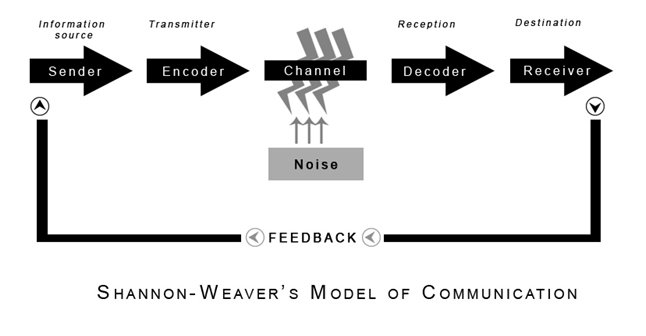
The model deals with various concepts like Information source, transmitter, Noise, channel, message, receiver, channel, information destination, encode and decode.
Sender : The originator of message or the information source selects desire message
Encoder : The transmitter which converts the message into signals
Note: The sender’s messages converted into signals like waves or Binary data which is compactable to transmit the messages through cables or satellites. For example: In telephone the voice is converted into wave signals and it transmits through cables
Decoder : The reception place of the signal which converts signals into message. A reverse process of encode
Note : The receiver converts those binary data or waves into message which is comfortable and understandable for receiver. Otherwise receiver can’t receive the exact message and it will affect the effective communication between sender and receiver
Receiver : The destination of the message from sender
Note : Based on the decoded message the receiver gives their feed back to sender. If the message distracted by noise it will affect the communication flow between sender and receiver
Noise: The messages are transferred from encoder to decoder through channel. During this process the messages may distracted or affected by physical noise like horn sounds, thunder and crowd noise or encoded signals may distract in the channel during the transmission process which affect the communication flow or the receiver may not receive the correct message
Note : The model is clearly deals with external noises only which affect the messages or signals from external sources. For example: If there is any problems occur in network which directly affect the mobile phone communication or distract the messages
Practical Example of Shannon-Weaver model of communication :
Thomson made call to his assistant “come here I want to see you”. During his call, noise appeared (transmission error) and his assistant received “I want” only. Again Assistant asked Thomson (feedback) “what do you want Thomson”.
Sender : Thomson
Encoder : Telephone (Thomson)
Channel : Cable
Noise : Distraction in voice
Reception : Telephone (Assistant)

Receiver : Assistant.
Due to transmission error or noise, Assistant can’t able to understand Thomson’s messages.
*The noise which affect the communication flow between them.
Criticism of Shannon-Weaver model of communication :
1. One of the simplest model and its general applied in various communication theories
2. The model which attracts both academics of Human communication and Information theorist to leads their further research in communication
3. It’s more effective in person-to-person communication than group or mass audience
4. The model based on “Sender and Receiver”. Here sender plays the primary role and receiver plays the secondary role (receive the information or passive)
5. Communication is not a one way process. If it’s behaved like that, it will lose its strength. For example: Audience or receiver who listening a radio, reading the books or watching television is a one way communication because absence of feedback
6. Understanding Noise will helps to solve the various problems in communication

The Newcomb’s Model (ABX model of communication)


THEODORE M.NEWCOMB (July 24, 1903) in Rock Creek, at the northeastern tip of Ohio and he was a great pioneer in the field of social psychology. Merely 50 years he worked for the improvement of human motivation, perception and learning to shape the deep understanding of social process. In 1929, he started his professional career in the department of psychology at University of Michigan. In 1931, he moved to Cleveland College, University of Western Reserve from University of Michigan. In 1934, he got a great offer from New Bennington College in Vermont which caused remarkable changes in his rest of his professional career. His works “Personality and Social Change” (1943), “Social Psychology” (1950). He published a new social approach in field of communication which is called “ABX” system (later it became Newcomb’s model) and it’s published in the name of “An Approach to the Study of Communicative Acts (1953)”. He published another great work in the field of social psychology called “The Acquaintance Process” (1961).
The New Comb’s model of communication was introduced by Theodore M Newcomb of the University of Michigan in 1953. He gives different approach to the communication process. The main purpose of this theory is to introduce the role of communication in a social relationship (society) and to maintain social equilibrium within the social system. He does not include the message as a separate entity in his diagram, implying it only by use of directional arrows. He concentrates on the social purpose of communication, showing all communication as a means of sustaining relationships between people. Sometimes it’s called as an “ABX” model of communication.

The Newcomb’s model works in a triangular format or A-B-X system

A – Sender

B – Receiver

X – Matter of Concern

The relationship between A and B is like student and teacher, government and public or newspaper and readers. Sender and Receiver may work in a same flow but the same time some factor like “X” may affect their flow of relationship. “X” it may be third persons, issue, topic or policy.
For Example:
Teachers introduce a new policy to increase the college timing from 6 hours to 8 hours.

A – Teachers B – Students X – Policy or issue

If both students and teachers are satisfied with this policy then the communication maintains its equilibrium status between them. Otherwise the flow of communication between “A” and “B” becomes trouble in the social system. If “A” or “B” is not ready to accept the policy then it will directly affect the social system and can’t maintain the equilibrium status. So Teachers”A” can convince students “B” as much as possible. Otherwise they have to make some adjustments in the Policy “X” and convince them towards the policy.

Thursday, September 19, 2019

Lasswell's Model of Communication

The Lasswell's Communication Model describes verbal communication and consists of five elements. Who says What, in Which channel, to Whom, with What effect? This model is also called a ‘linear model of communication’, ‘uni-directional process’ or ‘action model, because it describes a one-way process within communication. It is seen as one of the most influential communication models. The model consists of five components, that are used as an analysis tool for evaluating the entire communication process. The previous ‘W’ questions are the basis for these components. The answers to these questions provide insight into the communication between people.
The Lasswell Communication Model consists of the basic questions below, aimed at a component and the gaining of an analysis:


Who?
Component: This is the communicator, also called the sender, who formulates and spreads a message. The sender can also be an intermediary.
Analysis: This is about a management and audit analysis, that helps the sender to have the power to communicate.
What?
Component: This is the content of the message or the message that the sender spreads.
Analysis: The content analysis is related to the aim of the message and/or the secondary intent.
Which channel?
Component: The channel describes the medium or media that is/are used to convey and spread the message. The medium can consist of several communication tools, mass media and social media.
Analysis: The media analysis shows which medium is best used to convey a message to the receivers as effectively as possible.
To whom?
Component: This describes the receiver(s), such as a target group or an individual. With mass communication, there’s an audience.
Analysis: The target analysis shows who the message is meant for and how they are best reached and/or influenced.
With what effect?
Component: The effect is the result the message leads to. The so-called triangle of success ‘knowledge, attitude, behaviour’ is often used to describe the desired effect.
Analysis: The effect analysis will need to be started beforehand, so the messages can be aimed at and fitted to the target audience.
A Lasswell Communication Model example
Communication can be understood as more than Lasswell’s linear communication model. The model can work really well when providing communication advice for organisations, by answering all five questions. This way, a communications advisor or marketer more easily gets an idea in advance about which concrete campaign should be carried out. Such a campaign plan states which message is sent via which channels and to which specific target audience in order to reach the desired effect and keep the lines of communication open between the organisation and its target groups. This is illustrated by the practical example below:
Imagine a large perfume chain that wants to reach a younger audience aged between 15 and 25 years old. Up until now, their customer base has been women between 25 and approximately 55 years old. Research has shown that especially young girls and women are also interested in make-up and perfume, but that they prefer not to visit shops, but rather prefer to look for products online.
For the perfume chain, this is a new challenge that Lasswell’s communication model can help them with. The five components of the Laswell Communication Model are used and each corresponding question is answered. In doing so, advice is formed and can be used to develop the campaign:
1. Who is communicating?
The perfume chain themselves. They want to present themselves as a modern company that also offers products online.
2. What needs to be communicated?
The perfume chain has opened an online shop and is now active on social media. The online shop offers a wide range of make-up and perfumes from well-known brands and orders are delivered within 24 hours. The language use will be hip and short and in the 2nd person singular (you), to make a connection and make the young target group feel involved.
3. Which channel is going to be used?
Other than large billboards advertising the opening of the online shop, there will also be investment in Facebook advertising as well as other social media, such as Twitter and Instagram.
4. Who is the message intended for?These are girls and women between 15 and 25 years old who don’t go to perfume shops, but often order things online.
5. What effect does the campaign need to have?The goal is for the target group to subscribe to the newsletter via Facebook or the website, so they will receive weekly offers and more quickly decide to order via the Internet.

Paralinguistic Communication

Paralinguistics is a kind of nonverbal communication based on the qualities of your voice and the way you vocalize. In addition to the words you say (verbal communication), your voice includes lots of information that can be interpreted (often unconsciously) by those you are communicating with.
For example, your accent not only hints at where you are from, but can make you sound smart, sexy, scary or more depending stereotypes or what a listener associates with that accent.
Other qualities of your voice can be interpreted as well.
Paralinguistic communication is the study of voice and how words are said. When you open your mouth to speak, you reveal much about yourself that often has nothing at all to do with the words you are speaking.
Paralinguistic signals and cues refer to every element and nuance of your speech. Paralinguistic communication can be much more subtle than other forms of nonverbal communication.
For example, a loud, booming voice is not at all subtle. However, a firm voice that conveys conviction is more nuanced than a pointing finger, big gestures, or invading someone’s personal space.

Here are some common paralinguistic vocal cues and examples:

Rate/SpeedGenerally men speak faster than women. Rapid rates of speech (and quickly coming up with a response) have been correlated with composure and self-assurance.
For example, to establish instant vocal rapport and a more subtle connection, speak at a rate or speed similar to the person you are communicating with in conversation.
RhythmInternational languages have unique rhythms. It is important to note this because the global language for business today is still English.
For example, a person from France speaks at a different speed and rhythm than someone from Singapore. A French person will generally speak English using a rhythmical pace similar to their native French language.
A Singaporean Chinese person, whose first language is Chinese, will likely speak using a rhythmical pace similar to their native Chinese language rhythm. Therefore, the Singaporean Chinese will naturally speak English faster than the French person.
No matter what your native language is, if you match the rate and rhythm of speech of the slowest speaking person, it will be easier to communicate and connect on a paralinguistic level.
VolumeResearch indicates that confidence, assertiveness, and boldness are reflected in louder speech.
This doesn’t mean that you go around speaking loudly but if you need to “raise the stakes” or occur more assertive, raising your vocal volume will help you to do this.
PitchA high-pitched voice can often time sound squeaky or childlike. Many people associate lower pitches with greater credibility, maturity and authority. More men are born with low-baritone or bass-pitched voices and they rarely use the highest level of pitch that women use.
Business women often times find themselves in a vocal dilemma trying to force their natural speaking voice too low to be more accepted or to seem more professional. It is important to note that the pitches you choose to speak on most should be in your most powerful vocal range.
Even though a lower pitched voice is often considered more credible, you should never force your voice so low that you lose vocal power or vocal focus.
Inflection/Vocal variety Inflection refers to variations in pitch. Imagine a storyteller reading a book to children. You would expect an almost sing-song inflection. But too much inflection in other contexts, like the business world, can undermine credibility. On the other hand, we all know what it’s like to be nearly put to sleep by a monotone speaker who will definitely be perceived as less charismatic or even flat out boring.
One of the easiest ways to ensure your voice is never boring or monotonous is to warm up daily with a few singing exercises or a song in the shower.
Quality
Quality usually refers to the vocal characteristics that allow you to differentiate one voice from another. Is a person’s voice small, feminine, or shaky; thin, throaty, or aloof; tense, flat, grating, nasal, harsh, or shrill? All of these represent different vocal combinations of rate, pitch, and volume.
Record yourself to get a more realistic idea of what you sound like and ask several people you trust for their opinion and feedback on your vocal quality.
Intensity/Tone Finally, how emphatic are the statements? For example if someone says, “I want you to do it now!” The intense delivery can be a direct indicator of the speaker’s passion and commitment or lack of it. The tone also reveals emotions behind the words being spoken.
An assertive listener will be able to connect face to face and create instant rapport with someone on the telephone by being aware of the subtle nuances of paralinguistic communication.
When you match & mirror vocal characteristics without mockery but with the intention to authentically connect with the people you are speaking with, you will be amazed at how quickly and easily you can establish vocal rapport that leads to greater understanding and more efficient paralinguistic communication.
Being aware of your own paralinguistic vocal strengths and weaknesses will allow you to subtly influence your speaking and listening so that you will be a more powerful communicator.